
 back to discography page

BEST THING FOR YOU WOULD BE ME
The Irving Berlin Songbook
HighNote Records 2003HCD 7091
 |
|---|
 |
 |
 |
 |
| Listen to Wesla's
Music at "Wesla's iPod" |
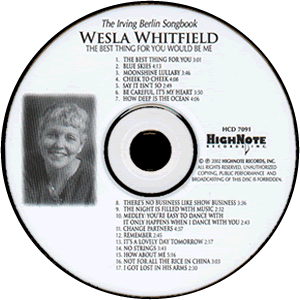
BEST THING FOR YOU WOULD BE ME
- the best thing for you
- blue skies
- moonshine lullaby
- cheek to cheek
- say it isn't so
- be careful it's my heart
- how deep is the ocean
- there's no business like show business
- the night is filled with music
- medley : you're easy to dance with / it only happens when i dance with you
- change partners
- remember
- it's a lovely day tomorrow
- no strings
- how about me
- not for all the rice in china
- i get lost in his arms

BEST THING FOR YOU WOULD BE ME
wesla whitfield: vocals
mike greensill: piano / arranger
john wiitala: bass
vince lateano: drums
gary foster: reeds
marty wehner: trombone
orrin keepnews: producer
BEST THING FOR YOU WOULD BE ME
Wesla Whitfield is not among those cabaret performers of a few years ago who have recently re-surfaced on the sales charts as jazz singers.
Whitfield, in fact, has been in the once-scorned jazz camp for most of her long career, and with her husband, Mike Greensill, has been instrumental in broadening and enhancing the cabaret repertoire to include all manner of American popular songs - such as those of Irving Berlin, Harold Arlen, Duke Ellington - which were ignored by those who concentrated on such sophisticates as Cole Porter and Noel Coward.
Though she grew up in the central coast town of Santa Maria, California, Whitfield was singing both popular and classical material in San Francisco by the mid-1970s. She sang in light-opera and Broadway productions, performed in musical-comedy troupes, survived the Edith Piaf and Jacque Brel folk-cabaret era, and for years has played the coast-to coast and trans-Atlantic cabaret circuit (Plush Room, Hollywood/Roosevelt Cinegrill, Algonquin Hotel, The Nest, Pizza on the Park, and all that).
Whitfield has appeared in concerts coast-to-cast, she's broadcast on "Prairie Home Companion", "Weekend Edition," "Fresh Air,""All Things Considered," "Piano Jazz" as well as recording regularly and establishing a loyal, extensive following.
As long as San Franciscans have been listening to Whitfield - and a number of years before she teamed up with her husband, pianist Mike Greensill - she has approached each song in the manner that a sculptor handles a mound of clay - or a seasoned jazz instrumentalist handles a new song or chart. She makes friends with a piece of music, treating the melody, harmony and rhythm (but not the lyrics) as variables - ingredients that can be dealt with on their own, or collectively, to produce an enhanced, distinctly personal rendition.
With Greensill as an arranger, pianist and ensemble leader, Whitfield feels comfortable, singing as she wishes against appropriate instrumental accompaniment. Many's the youngish singer who records relatively new material (selected by a company producer) accompanied by studio musicians playing lavish arrangements, only to find that she (or he) cannot relax when singing - and spending weeks and weeks assembling an hour's worth of recorded material in the studio is ridiculous.
Listen, for instance, to Whitfield's "Dance Medley" (Track 10) with Greensill's clever "Christopher Columbus" reference in the intro, followed by the swinging vocals on "You're Easy to Dance With", and "It Only Happens When I Dance with You" - the first from the early 1950s, the latter a few years earlier. Every nuance, every inflection of the voice is a part of the overall musical presentation.
The dance theme continues with "Change Partners", from Irving Berlin's "Carefree" 1938 movie score, sung in an intimate, in-your-ear manner, it's a logical conclusion piece for the quite delightful seven minute "dance" sequence.
Fourteen of these 17 Berlin songs are from the 1930s and 40s - the fourth and fifth decades of more than 60 years of song writing. For many observers, these were his most brilliant and imaginative period, with great, memorable, songs written for films, for Broadway shows and for the pop-music, Hit Parade audience.
These decades bridged the two World Wars. Berlin wrote popular songs for both conflicts, just as he had documented America's musical transition from popular ragtime ("Alexander's Ragtime Band", "Everything in America is Ragtime") to the post-World War I jazz era - stuff like "I Love A Piano", "Mandy", or the forgotten but lyrically prophetic, "Send a Lot of Jazz Bands Over There", from 1918. (The U.S. government didn't get around to sponsoring overseas tours by jazz bands until the 1950s).
From the 20's, the Whitfield-Greensill team here performs "Remember", "Blue Skies", and "How About Me?" - the first pair classic Berlin material that have lasted as standards into the 21st century, although Berlin threatened to bring suit in the 30s against swing bands which he thought ruined such of his songs as "Remember" and "Blue Skies". He quieted down when the royalty checks started rolling in.
However, he would have loved Whitfield's contemplative version of "Remember", and this slick, tight arrangement of "Blue Skies" also might well meet with his approval.
Whitfield's singing of "Moonshine Lullaby", a strangely forgotten gem from Berlin's finest musical, "Annie Get Your Gun", is classic stuff, and "Say It Isn't So", as well as "How Deep In The Ocean", both from 1932, are also gorgeously performed. All three are proof of Berlin's song-writing genius.
On two of this CDs selections Greensill's quartet becomes a quintet with the addition of Marty Wehner's effective trombone. The quartet, with the effervescent Greensill on piano, included top-drawer musicians Gary Foster on tenor and also saxes, clarinet and flute, the estimable John Wiitala on string bass, and the vastly underrated drummer Vince Lateano.
Berlin was an active songwriter (usually both words and music) for 60 of his 101 years - from 1907 -til 1967. He died in 1989. He was the all-American popular songwriter, always able to document the nation's needs, moods, anxieties and news events in song.
These notes were begun on the Labor Day weekend, 2001. The World Trade Center attacks came eight days later. By the second weekend after Labor Day, the nation was singing Irving Berlin's "God Bless America".
-- Philip ElwoodSan Francisco Chronicle

BEST THING FOR YOU WOULD BE ME
Planet Jazz Magazine
Winter/Spring 2003 issue
by: G. Evans
Wesla Whitfield
The Best Thing For You Would Be Me”
HighNote (HCD 7091)
Though Wesla may be an acquired taste, so is caviar, and each is well worth the time in learning to enjoy. Is she a jazz singer? Who really cares when her time is so delicious, her swing so genuine, and her ability to resurrect and restore original lyrics so profound.
Wesla was an actress at the outset of her career, but life threw her a curve ball. Since then she has built an imposing recorded legacy and established a strong reputation as a headliner in upscale venues across the United States, notably New York and San Francisco.
Another in a long series of successful collaborations with husband/pianist Michael Greensill, this Irving Berlin songbook goes to places both longed-for and unexpected, with all the verses to these favourite or forgotten Berlin songs intact and swinging. They make a great team the two of them, and in addition to Michael's superb trio, have a couple great horn soloists along for the ride, Gary Foster with reeds and Marty Wehner on trombone.
Wesla may be the Mabel Mercer of our time, a singer's singer with a totally unique sound and a love of song so intense that it outshines her need for the spotlight.
Listen to this one and learn.
Jazz Times Review
Artist: Whitfield, Wesla
Title of CD: The Best Thing For You Would Be Me
Record Label: HighNote
Reviewed by Christopher Loudon
in the Vox section of the June 2002 issue.
As Cy Coleman is to the New York cognoscenti, so Irving Berlin is to all folk, common or otherwise. Such is the magic of Berlin, that his songs not only stand the test of time but remain as equally resonant on the Upper East Side as they are in, say, Manhattan, Kan.
Over the years, everybody from Ella to Doris Day has taken a satisfying dip or 12 into the Berlin songbook.
Never before, though, has San Francisco's most prolific songbird, Wesla Whitfield, indulged us with an entire platter of Berlin tunes. Blessed with the rare ability to combine a keen jazz sensibility with a cabaret performer's respect for tradition, Whitfield is ideally suited to explore the subtle nuances that define the deceptive simplicity of Berlin's work. Dividing the 17 tracks that fill The Best Thing for You Would Be Me almost equally between ballads and uptempo numbers, and including an intriguing surprise or two among the standard fare, she provides her beautifully seasoned mezzo-soprano with a vigorous workout.
In less experienced hands, Berlin chestnuts like "Remember," "How Deep Is the Ocean?" and "How About Me?" can sound creakily melodramatic. Whitfield, however, skillfully avoids excess sentiment by maintaining a gentle caress that's soft but never too sweet.
Conversely, she knows precisely how to temper big, brassy numbers like "Blue Skies" and "There's No Business Like Show Business," never allowing the lyrics to become obscured by such songs' inherent bravado.
Particularly impressive is her seamless blending of "You're Easy to Dance With" and "It Only Happens When I Dance With You," with "Change Partners" as a stimulating chaser.
It's also a treat to hear her take a playful spin through the unfairly neglected "Not for All the Rice in China." There is, of course, a well-known secret to Whitfield's success. His name is Mike Greensill. As husband, arranger and accompanist, he is the yin to her yang.
In other words, on album after album, the best thing for her has been him.
